


7 Warning Signs Your Boiler Needs Replacing in Wigan
- Michael Beresford
- Jun 24
- 11 min read
Most homeowners in Wigan ignore their boiler until it stops working entirely, usually on the coldest morning of the year or just before Christmas. But here is the uncomfortable truth: a boiler that is about to fail almost always gives you weeks, sometimes months, of warning signs before it breaks down completely. According to the Energy Saving Trust, replacing an old G-rated boiler with a new A-rated condensing boiler can cut heating bills by up to 35 percent. If you are searching for boiler replacement in Wigan, this guide will tell you exactly what to look for before the situation becomes an emergency.
Table of Contents
Quick Takeaways
Key Insight
Explanation
Age over 15 years is a red flag
Most boilers have a reliable lifespan of 10 to 15 years. Beyond that, efficiency drops sharply and parts become harder to source.
A yellow or orange flame means danger
A healthy boiler burns with a crisp blue flame. Yellow indicates incomplete combustion and possible carbon monoxide leakage.
Repair costs above 50 percent of replacement cost signal it is time to replace
If a single repair quote is approaching half the price of a new boiler, replacement is almost always the better financial decision.
Kettling noise is not just annoying
A rumbling or kettling sound points to limescale build-up on the heat exchanger, which reduces efficiency and accelerates component failure.
Summer is the smartest window for boiler replacement in Wigan
Engineers are less stretched in summer, lead times are shorter, and you avoid the winter rush when emergency callouts take priority.
Constant pressure drops waste money and strain the system
If you are topping up the pressure more than once a month, there is likely an internal leak or a failing pressure vessel.
Uneven heating often points to a failing pump or heat exchanger
When certain radiators stay cold even after bleeding, the problem is often the boiler itself rather than the radiators.
Sign 1: Your Energy Bills Keep Climbing
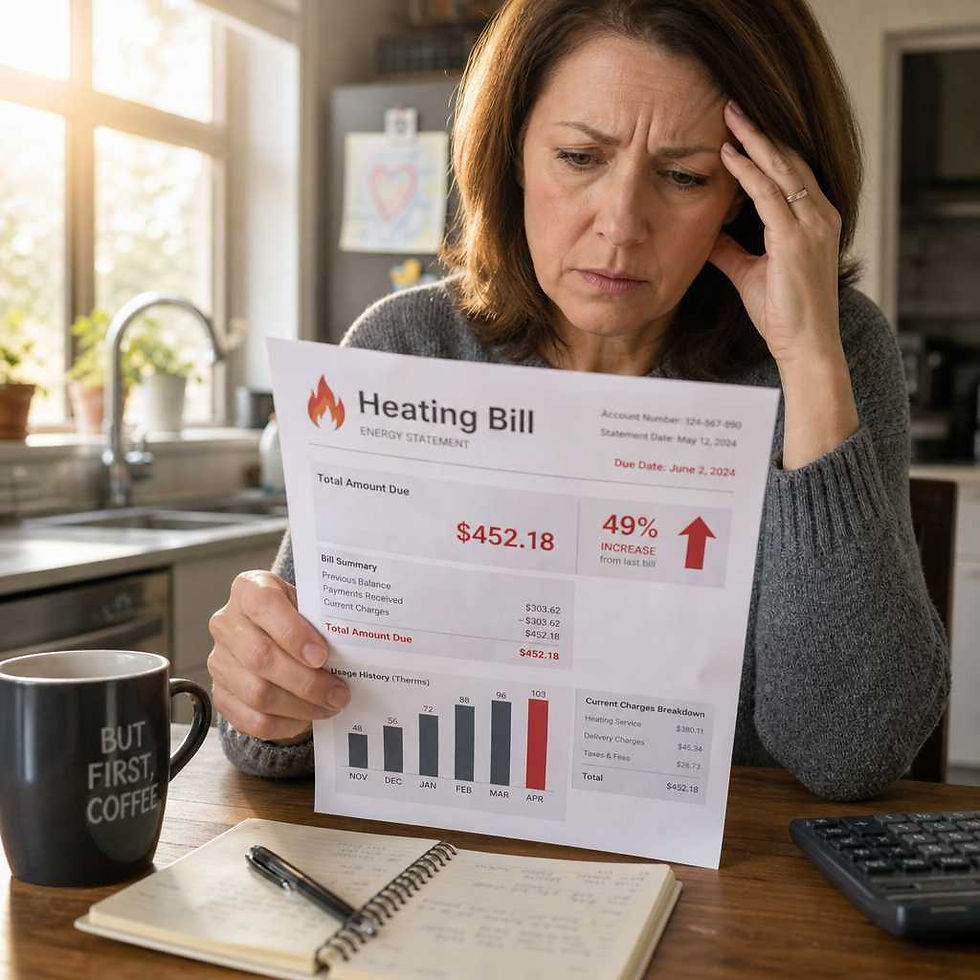
If your gas bill has crept up year on year but your usage habits have not changed, your boiler is the first place to look. Older boilers operate at efficiencies well below 80 percent, meaning more than 20p in every pound you spend on gas is wasted as heat that escapes through the flue rather than warming your home.
In practice, a boiler that was installed before 2008 in a typical three-bedroom semi-detached house in Wigan could be costing its owner several hundred pounds more per year than a modern A-rated condensing unit. The Energy Saving Trust puts the potential annual saving at between 200 and 315 pounds for a detached house when switching from a G-rated to an A-rated boiler. That saving compounds over years.
A common mistake is to blame the energy supplier and switch tariff without ever checking the boiler's efficiency rating. Check the ErP energy label on your boiler, or look up the model on the Boiler Plus scheme register. If it is rated below 88 percent, you are already losing money every single day the boiler runs.

Sign 2: Your Boiler Is Over 15 Years Old
The average lifespan of a well-maintained gas boiler is between 10 and 15 years. Beyond the 15-year mark, you are not just dealing with declining efficiency. You are dealing with parts that manufacturers no longer stock, meaning any repair becomes a hunting exercise that drives up both cost and waiting time.
Boilers installed in Wigan homes before 2010 are almost certainly non-condensing models. These were superseded by law for new installations under the 2005 Building Regulations, but existing units were not forced out. If your boiler has a large white plastic pipe exiting through an external wall rather than a condensate pipe running to a drain, it is almost certainly a non-condensing unit that cannot match the efficiency of anything available today.
Pro tip: Check the manufacture date on the boiler's data plate, usually found on the front or side casing. If the date is before 2009 and the boiler has not had a major service in the last two years, book a professional inspection before this winter rather than waiting for a breakdown.
Sign 3: You Are Calling for Repairs Every Few Months
One repair call in a year is normal. Two in quick succession is a warning. Three or more in a twelve-month period is a clear signal that the boiler is working against you rather than for you. Each repair carries its own labour charge, parts cost, and the hidden cost of time spent without hot water or heating in a North West England winter.
The data consistently shows that homeowners who replace a boiler reactively, after it fails completely in December or January, pay significantly more than those who plan the replacement in advance. Emergency call-out rates, weekend premiums, and the likelihood of needing temporary heating all add to the total cost of a reactive replacement.
At Neptune Plumbing and Heating, the team sees this pattern regularly across Wigan, Bolton, and Warrington. A boiler that has needed a new pump, then a new PCB, then a new diverter valve within 18 months is not a boiler that has three separate faults. It is a boiler that is failing systemically. Replacing individual components on an ageing unit is rarely the financially sound choice beyond a certain point.
Sign 4: Banging, Kettling, or Clunking Sounds
A healthy boiler runs quietly. If yours is making banging noises when it fires up, a low rumbling sound during operation, or clunking when it shuts down, each of these sounds points to a specific and diagnosable problem. The question is whether the problem is worth fixing or a sign of wider deterioration.
What kettling actually means
Kettling is the term for a rumbling sound similar to a boiling kettle, caused by limescale build-up on the heat exchanger. Wigan and much of the North West sits in a moderate hardness water zone, but scale still accumulates over time. Once the heat exchanger is heavily scaled, water overheats in localised pockets, turns to steam briefly, and creates that distinctive rumble. A power flush can sometimes resolve this, but on older boilers the heat exchanger is often too corroded to benefit fully.
Banging on start-up
A loud bang when the boiler ignites usually points to delayed ignition, where gas accumulates in the combustion chamber before the ignition spark fires. This is not a minor issue to defer. It stresses the combustion chamber walls, accelerates wear on the heat exchanger, and in severe cases poses a safety risk. A Gas Safe registered engineer must inspect this immediately.
Sign 5: The Flame Is Yellow Instead of Blue
This is the single most important safety warning sign on this list. If you have a boiler with a visible inspection window and the flame is yellow, orange, or flickering rather than a steady blue, stop using the boiler and call a Gas Safe registered engineer the same day. Do not wait until the next working day.
A yellow flame indicates incomplete combustion, which means the burner is producing carbon monoxide rather than converting it fully to carbon dioxide. Carbon monoxide is odourless, colourless, and responsible for around 40 deaths per year in the UK, according to the Health and Safety Executive. It is not a fault you troubleshoot yourself or monitor to see if it gets worse.
"Carbon monoxide poisoning causes around 4,000 accident and emergency attendances in England and Wales every year. Fitting an audible carbon monoxide alarm is essential, but it is not a substitute for a boiler that is operating safely." - Health and Safety Executive, UK
In practice, a yellow flame combined with an older boiler almost always leads to a recommendation for full replacement rather than repair. The combustion components that cause incomplete burning are expensive to replace and their failure is often a symptom of wider heat exchanger deterioration.

Sign 6: Some Rooms Are Always Cold
Uneven heating across a house is one of those problems that homeowners live with for years, assuming it is just how older houses work. In many cases it is not. Properly sized and balanced central heating should deliver consistent warmth to every room on the circuit.
When radiators in certain rooms consistently fail to reach temperature even after bleeding and balancing, the problem often traces back to a failing circulating pump or a partially blocked heat exchanger inside the boiler. Both of these are expensive repairs on older units, and both are signs that the boiler is struggling to deliver the output it was designed for.
Pro tip: Before assuming the boiler is at fault, check that all lockshield valves on radiators are open and that the system has been properly balanced. If those checks pass and rooms are still cold, the issue is almost certainly within the boiler or the main system pipework rather than individual radiators.
Sign 7: Leaks, Drips, and Constant Pressure Drops
A closed central heating system should hold its pressure without any intervention. The correct operating pressure for most domestic boilers is between 1 and 1.5 bar when cold. If yours is dropping below 1 bar regularly and you are topping it up via the filling loop more than once a month, there is a leak somewhere in the system.
Sometimes the leak is obvious, a visible drip from a radiator valve or a joint under the boiler. Sometimes it is internal, through a failing pressure relief valve, a leaking plate heat exchanger, or a degraded expansion vessel. Internal leaks are more serious because the water often drips onto the boiler's electrical components, causing secondary faults and corrosion damage that accelerates the boiler's overall decline.
Wigan homes with older unvented or open-vented systems sometimes tolerate small leaks for years without realising the cumulative damage being done to pipework and to the boiler's internals. By the time a heating engineer inspects the system, multiple components need replacing simultaneously, and the cost difference between repair and replacement narrows very quickly.
Repair vs Replace: How to Decide
One of the most common questions the team at Neptune Plumbing and Heating receives is whether a specific fault justifies replacement or whether a targeted repair will extend the boiler's life meaningfully. The answer depends on three variables: the boiler's age, its repair history, and the cost of the specific repair relative to replacement.
Scenario
Recommended Action
Reasoning
Boiler under 10 years old, first repair, fault is a single component such as a pump or valve
Repair
The boiler is within its reliable working life and a single component failure is normal. Repair cost is likely well under 50 percent of replacement.
Boiler between 10 and 15 years old, second or third repair in 18 months, repair quote over 500 pounds
Replace
Repeated failures on a mid-life boiler indicate systemic decline. The repair buys limited time and new faults are likely within months.
Boiler over 15 years old, any significant fault, parts difficult to source
Replace immediately
Beyond 15 years the boiler is past its reliable lifespan. Parts scarcity drives repair costs up. A new A-rated boiler pays back its cost through energy savings within several years.
Why Summer Is the Best Time for Boiler Installation in Wigan
Most homeowners put off boiler replacement because they do not want to be without heating. But summer is precisely when disruption is lowest. You do not need the heating to be on in July, so even if the installation takes a full day, you will not miss it.
Heating engineers across Wigan and the wider North West are significantly busier between October and February. Emergency callouts fill diaries, parts take longer to arrive, and the combination of high demand and supply pressure means prices can be higher. Booking a planned boiler installation in Wigan in summer typically means faster scheduling, more relaxed installation conditions, and the peace of mind that the new system has been properly commissioned and tested before the cold weather hits.
Neptune Plumbing and Heating offers summer boiler replacement across Wigan, Leigh, Bolton, Warrington, and Manchester. Because the business is family-run rather than a large corporate contractor, customers deal with the same engineers from survey through to installation and aftercare. That matters when something goes wrong during commissioning or when you have a question about your new controls three months after installation.
The Boiler Plus regulations introduced in 2018 also mean that any new boiler installation in England must include a time and temperature control device as a minimum. A professional installer will ensure your replacement boiler meets these requirements and is correctly registered with Building Control, protecting your property insurance and any manufacturer warranty.
Frequently Asked Questions
How much does boiler replacement in Wigan typically cost?
The cost of boiler replacement in Wigan depends on the boiler type, size, and any additional work required such as moving the flue position or upgrading pipework. For a straightforward like-for-like combi boiler replacement in a standard three-bedroom house, prices typically range from 1,500 to 2,500 pounds including installation. Larger properties or system boiler replacements will sit at the higher end of that range or above it. Always get at least two itemised quotes from Gas Safe registered engineers before committing.
How long does a boiler installation take?
A straightforward combi boiler swap in a Wigan home usually takes between four and eight hours for a competent Gas Safe engineer. If the installation involves a change of boiler type, new pipework runs, or a flue relocation, allow for a full day or potentially two. Neptune Plumbing and Heating aims to complete most residential boiler replacements in a single working day.
Do I need to be home for the boiler installation?
Yes. The engineer will need access to the boiler location, the gas meter, the cold water stopcock, and in many cases radiators throughout the property. Someone over the age of 18 must be present for the full duration of the installation. At the end of the job, the engineer will walk you through the new boiler controls and provide documentation including the Gas Safe certificate and manufacturer warranty registration.
Can I get any financial help toward boiler replacement costs?
Yes, depending on your circumstances. The UK Government's Energy Company Obligation (ECO4) scheme provides funding toward boiler replacement for households on certain benefits or with low energy performance ratings. The Great British Insulation Scheme also runs alongside ECO4. Eligibility criteria change periodically, so check the current rules on the GOV.UK website or ask your installer to assess your eligibility before paying in full.
What brand of replacement boiler should I choose?
Worcester Bosch, Vaillant, and Viessmann are consistently rated as the most reliable boiler brands in independent customer satisfaction surveys. All three offer warranties of between five and ten years on selected models when installed by accredited engineers. The right model for your home depends on your hot water demand, property size, and existing heating system type. A heating engineer who surveys your property before quoting will recommend the appropriate output size, which is more important than brand loyalty.
Is a yellow flame always an emergency?
Yes. A yellow or orange flame on a gas boiler indicates incomplete combustion and the potential production of carbon monoxide. Turn off the boiler, open windows, leave the property if you feel unwell, and call a Gas Safe registered engineer immediately. Do not attempt to restart the boiler or continue using it until it has been inspected and declared safe. If anyone in the household shows symptoms of carbon monoxide poisoning such as headache, dizziness, or nausea, call 999.
If you have spotted any of these warning signs in your Wigan home, we would love to hear about your experience and answer any questions you have in the comments below.
We would love your feedback and any insights you would share with others. What perspective would you add?
References
UK Government guidance on improving home energy efficiency and boiler upgrade schemes
Energy Saving Trust resources on boiler efficiency ratings and heating costs for UK homes
Health and Safety Executive information on carbon monoxide risks from gas appliances
Statista data on UK household energy consumption and heating system statistics


Comments