


Wall Panel Bathrooms Leigh: The Smart Choice Explained
- Michael Beresford
- Aug 4
- 11 min read
Most homeowners in Leigh spend weeks agonising over bathroom tiles, only to find themselves re-grouting cracked joints within three years. Wall panel bathrooms solve that problem at the root. Rather than rows of individual tiles bedded in grout that traps mould and moisture, wall panels are large-format, seamless sheets that bond directly to your wall surface. The result is a cleaner look, a faster installation, and a surface that genuinely stays hygienic with minimal effort. If you are considering a wall panel bathroom in Leigh or anywhere across the Wigan area, this guide explains exactly what you are buying and whether it is worth the investment.
Table of Contents
Quick Takeaways
Key Insight
Explanation
Grout-free surface means genuine mould resistance
With no grout lines, damp air in Leigh's climate has nowhere to accumulate and breed black mould.
Installation is typically 1-2 days faster than tiling
A skilled fitter like Neptune Plumbing and Heating can complete a full bathroom panel fit in a single day in most Leigh terraced homes.
PVC panels start from roughly £20-£30 per square metre
High-gloss acrylic and stone-effect panels cost more, but all options undercut the long-term maintenance cost of grout-heavy tiling.
Not all panels suit all wall conditions
Older Leigh properties with timber-framed walls need correct substrate boarding before panels can be fitted properly.
Panels can go over existing tiles in many cases
If existing tiles are sound and flat, fitting panels directly over them saves the cost and disruption of a full strip-out.
Seam placement matters as much as panel choice
Poor seam positioning near shower spray zones is the number-one cause of water ingress in panel installations.
Modern bathroom fitting in the North West increasingly favours panels
Demand for panel bathrooms across Wigan, Bolton, and Manchester has risen sharply as homeowners prioritise low-maintenance finishes.
What Are Wall Panel Bathrooms?
A wall panel bathroom replaces individual ceramic or porcelain tiles with large rigid sheets that cover an entire wall section from floor to ceiling or from worktop height upward. The panels interlock using a tongue-and-groove or clip system, and the joints are sealed with a colour-matched trim rather than grout. The overall effect is a flat, continuous surface with the appearance of a high-end finish at a fraction of the long-term maintenance cost.
The technology is not new. Commercial wet rooms and hotel bathrooms have used large-format panelling for decades because it holds up under heavy daily use. What changed over the last ten years is the quality of domestic-grade panels. Today's products can convincingly replicate marble, travertine, concrete, or brushed metal finishes without looking cheap.


There are three broad categories of panel on the UK market: PVC cladding panels, acrylic shower panels, and solid-core composite panels. Each has different thickness, rigidity, and price points. The right choice depends on your wall condition, your budget, and the specific room layout, which is exactly what an experienced bathroom installer assesses before recommending a product.
How Panels Differ from Wet Wall and Splashback Sheets
A common source of confusion is the distinction between full bathroom wall panels and simple splashback sheets. Splashback sheets cover only a small section of wall directly behind a bath or basin. Full wall panels, by contrast, are designed to wrap an entire bathroom. The waterproofing performance, edge trim systems, and structural requirements are completely different. Do not let a supplier sell you splashback material and call it a full panel system.
Why Wall Panels Make Sense for Leigh Homes
Leigh sits in a part of Greater Manchester that sees consistent rainfall and high ambient humidity through autumn and winter. Older housing stock in the area, particularly the two-up two-down terraces around Leigh town centre and the semi-detached 1950s and 60s builds in surrounding streets, often have bathrooms that lack adequate ventilation. That combination of climate and construction creates near-ideal conditions for grout mould, tile delamination, and persistent damp smells.
Wall panels remove the problem at source. There is no grout to absorb moisture, no hairline cracks for water to track behind tiles, and no porous ceramic surface holding condensation. In practice, homeowners who switch to panels report cleaning their bathroom walls with a single wipe rather than scrubbing grout lines with a brush.
"The bathroom wall is the most demanding surface in any home. It faces daily heat, steam, cold air, cleaning chemicals, and physical contact. A finish that cannot handle all five simultaneously will fail faster than the homeowner expects." -- Written guidance from the UK Bathroom Manufacturers Association on material selection standards.
Beyond humidity resistance, wall panels suit Leigh homes because many of these properties are rented or owner-occupied without large renovation budgets. A panel installation causes minimal disruption: no wet trades waiting for adhesive and grout to cure, no days of the bathroom being out of use, and no skips full of broken tile waste sitting outside on narrow Victorian terraced streets.
Pro tip: If you are planning a bathroom installation in Wigan or Leigh specifically, ask your installer whether the existing plasterboard or render is sound enough to take panels directly. Neptune Plumbing and Heating carries out a wall condition check before any panel fit, which prevents the most common cause of panel failure in older properties.
Wall Panels vs. Tiles: An Honest Comparison
This question comes up in almost every bathroom consultation, and the honest answer is that panels win on most practical criteria for the average Leigh homeowner. Tiles win mainly on longevity of the substrate itself and the ability to replace a single damaged section without disturbing the whole wall. Here is a structured look at how the two approaches compare across the metrics that actually matter.
Factor
Wall Panels
Ceramic or Porcelain Tiles
Installation time (average Leigh bathroom)
4-8 hours for a standard bathroom
2-4 days including adhesive and grout cure time
Mould resistance
High: no grout lines for mould to colonise
Low to medium: grout absorbs moisture and stains within 1-3 years
Long-term maintenance cost
Low: wipe-clean surface, no re-grouting needed
Medium to high: grout replacement every 3-7 years
Upfront material cost per square metre
£20-£80 depending on product grade
£15-£150 for tiles, plus adhesive, grout, and trim
Suitability for older Leigh properties
Good: lightweight, can go over existing sound tiles
Moderate: adds weight, requires flat substrate
Perceived premium finish
High with acrylic or composite panels
Very high with large-format porcelain slabs
The data consistently shows that re-grouting and mould remediation are the leading sources of bathroom maintenance complaints among UK homeowners. A 2023 survey cited by Which? magazine found that bathroom maintenance was ranked the most frustrating home upkeep task by 34 percent of respondents, and grout was specifically named as the primary culprit. Panels address that complaint directly.
Materials and Finishes Available
Choosing the right panel material is where most homeowners need guidance. The finish you see in a showroom will not always perform identically in a steamy North West bathroom. Here is what each type actually delivers in real conditions.
PVC Cladding Panels
PVC panels are the most affordable entry point. They are lightweight, fully waterproof, and available in a wide range of colours and printed finishes. A common mistake is assuming that low price means low quality. Many PVC panels carry a 10-year manufacturer guarantee and perform exceptionally well in high-humidity rooms. The weakness is that they dent under impact more easily than harder materials, which matters in a busy family bathroom.
Acrylic Shower Panels
Acrylic panels offer a high-gloss finish that genuinely resembles a seamless surface. They are harder than PVC, resistant to scratching under normal use, and available in a wide colour palette including solid colours and stone-effect prints. Most quality acrylic panels are 4mm to 8mm thick, which gives them a solid feel when tapped. These are Neptune Plumbing and Heating's most frequently specified panel type for bathroom installation in Wigan and Leigh.
Solid-Core Composite Panels
Composite panels are the premium tier. Products like Multipanel or Showerwall use a solid core of MDF or composite material faced with a high-pressure laminate. They are extremely rigid, can be cut with standard woodworking tools, and accept edge trims cleanly. The downsides are weight and cost. A solid composite panel bathroom costs 30 to 50 percent more in materials than a comparable PVC installation, but the finish is noticeably superior and the panels handle heat and moisture cycling better over a 15-plus year lifespan.
Pro tip: For a rented property in Leigh, PVC panels are the pragmatic choice. For a family home where the bathroom is a long-term investment, specify acrylic or solid composite. The difference in material cost is recovered quickly in reduced maintenance and tenant satisfaction.
What the Installation Process Actually Looks Like
Understanding the installation process helps you ask better questions of any installer you hire, including being able to spot shortcuts that will cause problems later.
The process starts with a wall condition assessment. The installer checks for damp, soft plaster, uneven surfaces, and existing tile adhesion. In older Leigh terraces, it is common to find plasterboard that has absorbed moisture from historic leaks or inadequate ventilation. That substrate must be replaced or overlaid with moisture-resistant board before any panel goes on.
Next, panels are measured, cut, and dry-fitted before any adhesive is applied. This dry-fit stage is non-negotiable for a quality installation. It identifies where trims are needed, where seams will fall relative to shower fittings and taps, and whether any walls are so out of plumb that packing is required. A good installer will spend as much time in the dry-fit stage as in the final adhesive stage.
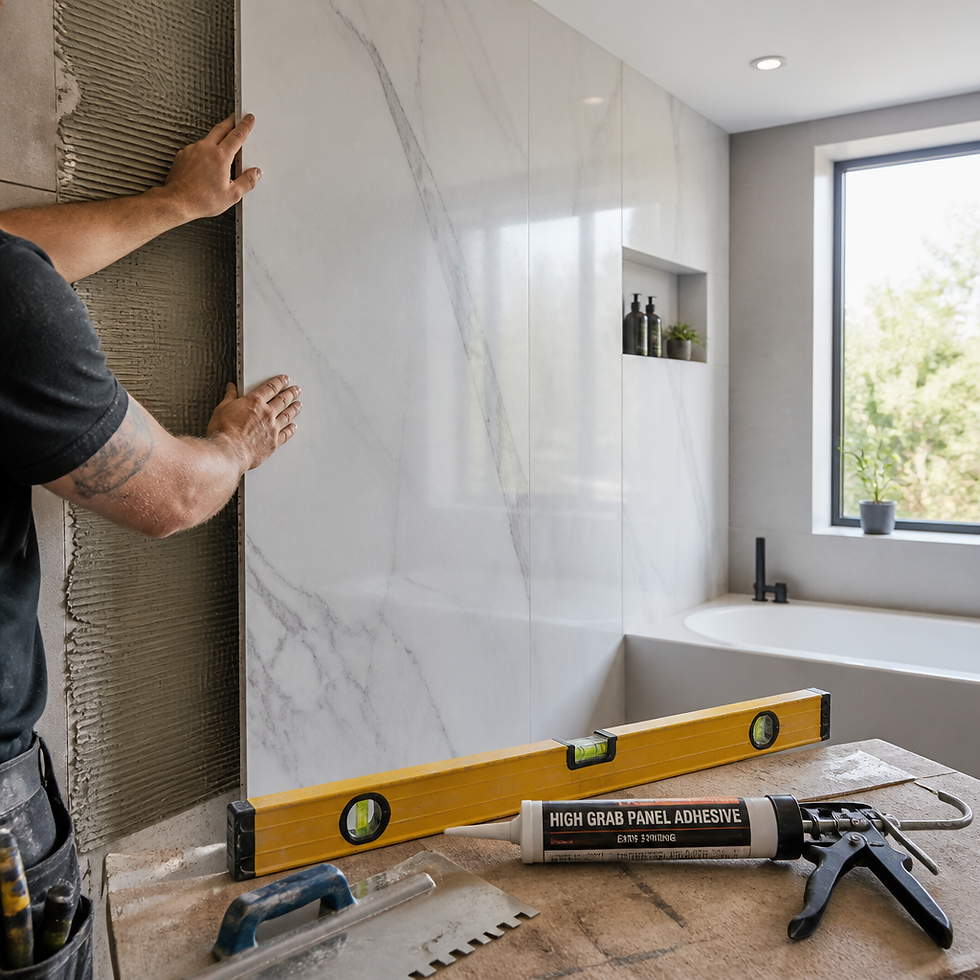
Adhesive is then applied to the panel back or wall surface depending on the product specification. Most quality panel adhesives are solvent-free and cure within two to four hours. Panels are fitted in sequence, pressed firmly, and held in place with temporary fixings while the adhesive grabs. Trim profiles are fitted at corners, edges, and floor junctions using silicone sealant rather than grout. The silicone joint is the last line of defence against water ingress, and it must be applied cleanly and continuously with no gaps.
The entire installation for a typical Leigh bathroom, including shower enclosure walls, bath panel, and basin splashback area, takes between four and eight hours with an experienced two-person team. That means your bathroom is usable again the same day or the morning after, compared to three to five days for a fully tiled installation waiting on adhesive and grout to cure.
Cost of a Wall Panel Bathroom in Leigh
Pricing transparency matters. Here is what a realistic wall panel bathroom installation costs across the Leigh and Wigan area in 2024, based on standard residential bathroom sizes and common specification levels.
A small bathroom, roughly 3 to 4 square metres of wall coverage, using mid-grade PVC panels typically runs to £600 to £900 in total including materials, trims, silicone, and labour. Moving to acrylic panels of comparable wall coverage adds £150 to £300 to the material cost. A full bathroom refit including bath, basin, toilet, and all wall panelling using solid composite panels in a standard Leigh semi-detached home ranges from £2,500 to £4,500, depending on whether existing plumbing positions are retained or moved.
Those figures assume the existing substrate is sound. If boarding-out is needed, add £150 to £400 depending on the extent. If existing tiles need to be stripped rather than overclad, add a day of labour and disposal cost.
Compare that to a fully tiled equivalent. Tiling materials, adhesive, grout, trim, and labour for the same bathroom typically cost 20 to 35 percent more upfront, and that excludes the re-grouting and sealing maintenance cost over the following decade. When homeowners in Leigh and Wigan see that comparison laid out clearly, the decision rarely takes long.
Modern bathroom fitting in the North West has shifted noticeably toward panels precisely because installers who show clients the ten-year cost picture find tiles difficult to justify for most domestic applications.
Common Mistakes to Avoid
A common mistake is choosing a panel purely on the basis of a showroom photograph without asking about the panel thickness, rigidity, or warranty terms. Thin PVC panels under 5mm feel hollow when pressed and are prone to flexing at adhesive contact points, which eventually leads to panels lifting from the wall. Always ask for the product data sheet and check that the panel carries a minimum five-year waterproof guarantee.
A second mistake is failing to specify the correct silicone type. Standard white bathroom silicone will discolour and crack within two years in a high-humidity shower enclosure. Specify an anti-mould, low-modulus silicone formulated for wet room applications. The cost difference is negligible. The performance difference is significant.
A third mistake, specific to Leigh and Wigan's older housing stock, is skipping the ventilation upgrade when fitting panels. Panels eliminate grout mould, but if the room ventilation is inadequate, condensation will form on the panel surface, migrate to joins, and eventually cause silicone failure. Neptune Plumbing and Heating routinely recommends upgrading to a humidity-sensing extractor fan as part of any bathroom installation in Wigan properties, because the extractor cost is trivial compared to the cost of remedial work from condensation damage.
A fourth mistake is assuming any builder or general handyman can fit wall panels to the same standard as a specialist bathroom installer. Panel systems require precise measurement, clean cutting without chipping, and correct silicone technique. Poor seam alignment and inadequate silicone at panel junctions are the leading causes of panel installation failures across the North West. Always use a specialist with demonstrable bathroom installation experience and references from completed jobs in the local area.
Frequently Asked Questions
Can wall panels be fitted in an older Leigh terraced house without major structural work?
Yes, in most cases. The key variable is the condition of the existing walls. If plaster is sound and dry, panels can be adhered directly. If there is historic damp or soft substrate, moisture-resistant boarding is fitted first. Neptune Plumbing and Heating always carries out a wall condition check before specifying a panel system, so there are no hidden costs after work begins.
How long do wall panel bathrooms last compared to tiled bathrooms?
Quality acrylic and composite panels carry manufacturer guarantees of 10 to 25 years. In practice, the panels themselves rarely fail. The silicone seals at joints and edges are the maintenance point, typically needing inspection every five to seven years and potential re-sealing every eight to twelve years. That is still significantly less maintenance than re-grouting a tiled bathroom, which most homeowners need to do every three to five years.
Can wall panels go over existing tiles without removing them?
Yes, provided the existing tiles are firmly bonded, flat, and the wall can carry the additional weight. This is one of the most practical advantages for bathroom installation in Wigan and Leigh, where stripping old tiles from Victorian plaster walls risks damaging the underlying structure. An installer should always check tile adhesion by pressing each tile firmly before recommending overclad versus strip-out.
Are wall panels suitable for a shower enclosure, or just bath surrounds?
Wall panels are fully suitable for shower enclosures, including walk-in wet rooms. They are actually superior to tiles in shower applications precisely because there are no grout lines in the spray zone to absorb water or harbour bacteria. The critical factor is correct seam placement, keeping all panel joints out of the primary spray zone where possible, and applying a continuous silicone bead at every junction.
What is the difference between PVC cladding panels and high-pressure laminate panels?
PVC cladding is a hollow or foam-core extruded plastic profile, typically 5mm to 10mm thick. High-pressure laminate panels, such as Multipanel or Showerwall, are a rigid MDF or composite core with a decorative laminate face bonded under high pressure. The laminate panels are harder, heavier, and more expensive, but deliver a more premium finish and handle repeated impact and cleaning better over a long lifespan. For a high-use family bathroom in Leigh, laminate panels are the better long-term choice despite the higher upfront cost.
Does Neptune Plumbing and Heating supply and fit wall panels, or just fit panels the customer supplies?
Neptune Plumbing and Heating offers both supply-and-fit and fit-only services for wall panel bathrooms across Leigh, Wigan, Bolton, Warrington, and Manchester. Supply-and-fit is simpler for most homeowners because the installer takes responsibility for product specification, correct quantity ordering, and warranty coordination. If you have already purchased panels, the team will assess them before committing to the installation to ensure the product is suitable for your specific wall conditions.
How quickly can Neptune Plumbing and Heating schedule a bathroom panel installation in Leigh?
Lead times depend on current workload, but as a local Leigh-based business, Neptune Plumbing and Heating typically schedules residential bathroom panel installations within one to two weeks of the initial consultation. Emergency plumbing callouts that involve panel bathroom work, such as burst pipe repairs where panelling needs to be removed and replaced, are handled within the 24-hour emergency callout service. Contact the team directly for current availability.
Have you recently considered switching from tiles to wall panels in your Leigh or Wigan home? Share your questions or experience in the comments and the Neptune Plumbing and Heating team will offer specific advice for your situation.


Comments